
Odds shopping means checking several bookmakers and taking the best price for a bet you already plan to make. At first, it sounds like a small habit. However, over hundreds of bets, the gap between an average price and the best price can decide whether your record ends up in profit or not.
For that reason, this guide shows what the best price is worth, with a worked example you can check yourself.
The short version
- Odds shopping changes nothing about your picks. It only changes the price you get for them.
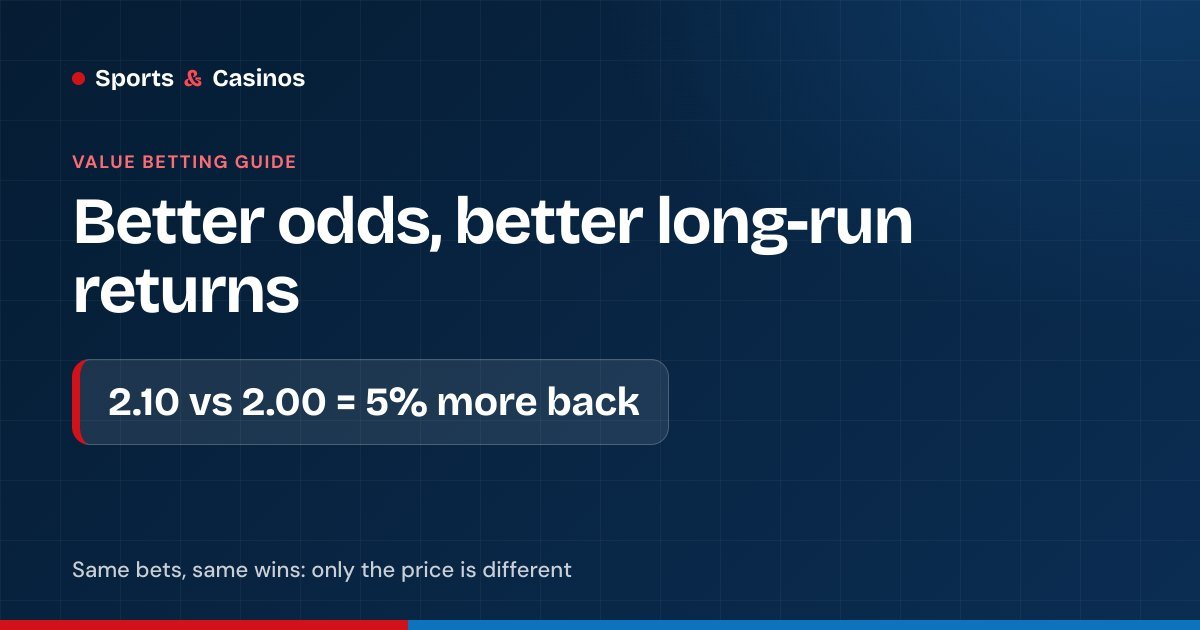
- With the same win rate, odds that are 5% higher return 5% more on every winning bet.
- Over 100 bets of £10, 2.10 instead of 2.00 is worth £50 at a 50% win rate.
- Better prices lower the bookmaker’s margin against you. They do not promise a profit.
What is odds shopping?
First, note that different bookmakers set different prices for the same event. For example, one firm may offer 2.00 (evens) on a team to win, while another offers 2.10 (11/10). Yet the chance of that team winning is the same at both firms, so only the payout changes.
So odds shopping is simply comparing those prices before you place a bet. It is the easiest edge-related habit to build, because it needs no model and no forecasting. Instead, you just need accounts with a few licensed UK firms and a few minutes to compare.
Odds shopping in numbers: 100 bets at 2.00 vs 2.10
So let’s put real numbers on it. For example, imagine you place 100 bets of £10 each. In both cases, you pick the same selections and win the same number of bets. As a result, the only difference is the price.
Worked example
You stake £10 on 100 bets, so £1,000 in total. You win 50 of them, a 50% win rate.
- At 2.00, each winner returns £20. That is 50 × £20 = £1,000 back, so your profit is £0 and your yield is 0%.
- At 2.10, each winner returns £21. That is 50 × £21 = £1,050 back, so your profit is £50 and your yield is 5%.
Now drop the win rate to 48%, so you win 48 bets.
- At 2.00: 48 × £20 = £960 back, £40 down (−4%).
- At 2.10: 48 × £21 = £1,008 back, a profit of £8 (+0.8%).
In both cases, the better price adds the same thing: 0.10 extra on every winning £1, which is 10p per £1 on each winner. With 50 winners at £10, that is £50. With 48 winners, it is £48. The picks stayed the same, yet the result moved by almost 5% of everything you staked.
How a few per cent adds up
Of course, you won’t always find a 5% gap. Even so, small gaps still matter, because they apply to every bet you place. The table shows the same 100 bets of £10 at a 50% win rate, at different prices.
| Odds taken | Better than 2.00 by | Returned | Profit | Yield |
|---|---|---|---|---|
| 2.00 | 0% | £1,000 | £0 | 0% |
| 2.02 | 1% | £1,010 | £10 | 1% |
| 2.04 | 2% | £1,020 | £20 | 2% |
| 2.06 | 3% | £1,030 | £30 | 3% |
| 2.10 | 5% | £1,050 | £50 | 5% |
In short, the rule is simple. If your win rate stays the same, every 1% you add to the odds adds 1% to your total returns. That means odds shopping moves your yield almost point for point. Our guide to expected value betting shows the same idea with EV per £1.
Why the best price matters for value
First, every price contains a margin for the bookmaker. When you take the best price in the market, you pay the smallest margin on that bet. Also, sometimes the best price is even longer than the fair price, which is where value comes from. Our fair odds guide shows how to work that out, and our sharp bookmakers guide explains which prices make the best yardstick.
Next, use the calculator below to test it. Enter your stake, the odds and your own estimate of the chance, then try a few prices to see how the EV and edge change.
Expected value calculator
How to do odds shopping well
- Decide the bet first. Pick the selection on its merits, then look for the price. Don’t let a big price talk you into a bet you didn’t want.
- Compare like with like. Check that the market rules match, for example how each firm settles extra time or a void bet.
- Allow for commission. On an exchange, you pay commission on net winnings. So check the current rate and compare the price after commission.
- Stick to licensed firms. Only use operators licensed by the Gambling Commission.
- Record the price you took. A simple log shows whether your odds shopping is working. Our guide to betting records explains what to track.
Odds shopping with our Value Predictor
Our free Value Predictor flags games where both teams have hit a goals market often in recent matches. Where a live odds feed is available, it also shows the best UK odds for each pick, so part of the odds shopping is done for you.
Bear in mind that the Value Predictor shows statistics, not tips. After all, a team’s recent goal record does not tell you the true chance on its own. So compare the best price with your own view of the chance before you decide whether a bet is value.
Honest limits of odds shopping
Odds shopping lowers the margin you pay. However, it does not create an edge by magic, and it does not remove luck. For example, over 100 bets, the swings from variance are often far bigger than £50. Our guide to betting variance shows how wide those swings can be.
Also, some bookmakers limit accounts that often take the best price. That is a legal, commercial decision. Treat the best price as a way to waste less, not as a route to income. Set a budget and only stake what you can afford to lose.
Related guides
18+ only. Betting should be fun, and every bet can lose. Set a budget you can afford to lose and stick to it. For free, confidential support, visit BeGambleAware.org or call the National Gambling Helpline on 0808 8020 133.