
To green up means placing a second bet on a betting exchange so that your result is the same whatever happens in the match. If the price has moved your way, you lock in a small profit on every outcome. The same method works whichever way the price has moved, because it simply levels your position.
This guide gives the exact sums for both kinds of trade, with worked examples. It also explains commission and the costs to watch.
The short version
- Backed first? Lay stake = back stake × back odds ÷ lay odds.
- Laid first? Back stake = lay stake × lay odds ÷ back odds.
- The result is then the same on every outcome, before commission.
- It only fixes the result of a price move. It does not make a trade good value.
What does green up mean?
Exchanges such as Betfair show your position on each outcome in a market. Positive figures show in green, and negative figures show in red. So when your figures are green across the board, you are “all green”. Traders use green up as a verb for getting there.
Read the transcript
Greening up means spreading a trading profit evenly across every outcome. Here's the sum.
If you backed first, your lay stake is your back stake times the back odds, divided by the current lay odds.
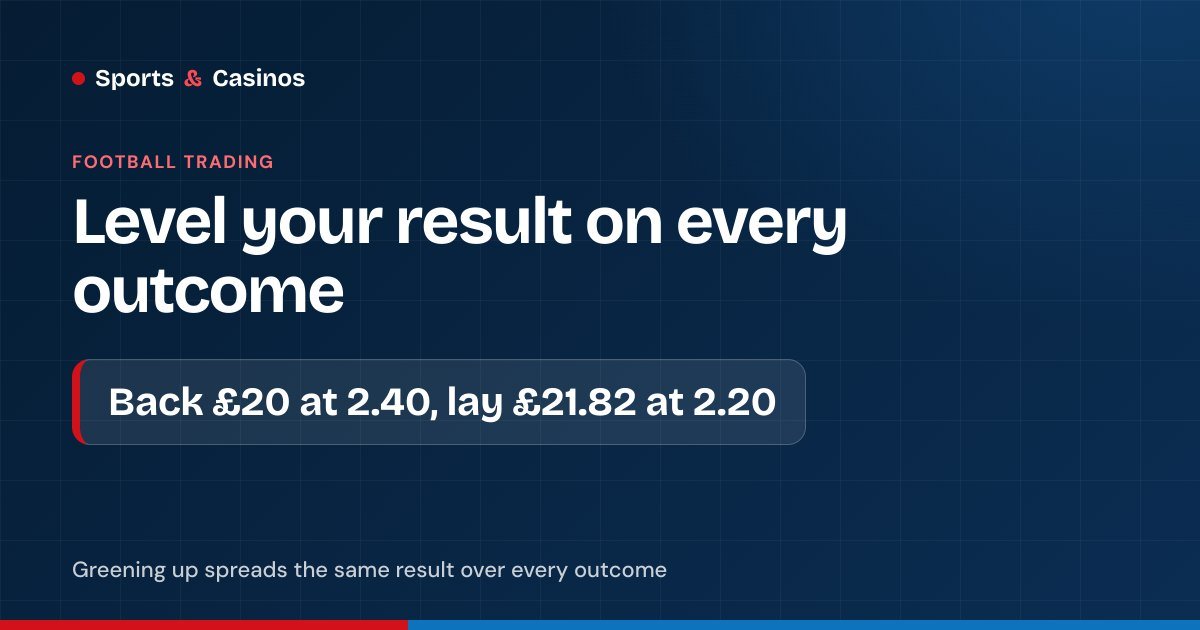
Say you backed twenty pounds at two point four. If the price shortens to two point two, lay twenty-one pounds eighty-two, and you're up one eighty-two whatever happens. At two point one, lay twenty-two eighty-six, and you're up two eighty-six.
If you laid first, flip it. Your back stake is the lay stake times the lay odds, divided by the back odds.
Before you click, check there's enough money waiting at your price. Commission comes off your net winnings, so factor it into small trades.
Greening up locks in your position across every result. Please bet responsibly.
The idea only works on an exchange, because you need to be able to lay as well as back. Our guide to the Betfair Exchange explains the two sides of an exchange bet. For the wider picture, see our football trading guide.
How to green up step by step
- Note your first bet: the stake, the odds and whether you backed or laid.
- Check the current price on the other side. If you backed, look at the lay price. If you laid, look at the back price.
- Work out the closing stake with the right sum from the box above.
- Place the closing bet and check it is fully matched.
- Check your position. Each outcome should now show about the same figure.
Most exchanges and trading tools also have a “cash out” or green up button that does these sums for you. However, it helps to know the maths, because then you can see exactly what you are locking in and what the closing bet costs.
Worked example: green up after backing first
This is the classic back to lay trade. You back at one price and hope it shortens, so you can lay at a lower price.
Worked example
You back a team for £20 at 2.40. The price shortens to 2.20.
- Lay stake: £20 × 2.40 ÷ 2.20 = £21.82.
- If the team wins: the back pays £20 × 1.40 = £28. The lay costs £21.82 × 1.20 = £26.18. Net: +£1.82.
- If the team does not win: the lay wins £21.82, and the £20 back stake is gone. Net: +£1.82.
- Quick check: £20 × (2.40 ÷ 2.20 − 1) = £1.82.
Commission is then taken from the net win in that market. At 2%, that is about 4p. At 5%, used here only as an example rate, it is about 9p.
Our guide to back to lay trading covers this strategy in full.
Worked example: green up after laying first
The sums flip when you lay first. Now you want the price to drift out, so you can back at a higher price. Lay the draw is the best-known example.
Worked example
You lay the draw for £10 at 3.60, so your liability is £10 × 2.60 = £26. A goal goes in on 30 minutes, and the draw drifts to 5.50.
- Back stake: £10 × 3.60 ÷ 5.50 = £6.55.
- If the match is a draw: the back pays £6.55 × 4.50 = £29.48. The lay costs £26. Net: about +£3.48.
- If it is not a draw: the lay wins £10, and the £6.55 back stake is gone. Net: +£3.45.
- Quick check: £10 × (1 − 3.60 ÷ 5.50) = £3.45.
The two results differ by a few pence because the stake is rounded to the nearest penny. Commission at 2% on £3.45 is about 7p.
The full strategy is in our guide to lay the draw.
What the data says about price moves
To green up for a profit, the price has to move your way first. So it helps to know how prices usually move. We compared Betfair Exchange prices days before kick-off with prices at kick-off, over more than 6,500 matches.
Prices drifted out more often than they shortened between those two points. These are averages across many matches. They describe the market, not a strategy.
The market’s own prices also got more accurate as kick-off neared, with the match odds margin falling from 2.8% to 0.9%. In other words, early prices carry a bigger margin, and the price you back at early is not automatically better than the one at kick-off.
The honest limits of greening up
Greening up is a tool for managing a position. It is not a source of profit. The closing bet is placed at the market’s current price. All it does is spread whatever the price move gave you across every outcome.
That means any long-run profit depends on the first bet, not the green up. You would need to judge prices better than the market, and commission makes small trades harder still. If you want to test your judgement, our guide to closing line value shows how to compare your prices with the final market.
Also, green up sums assume your closing bet is matched at the price you see. In fast in-play markets, prices can move during the bet delay. As a result, the figure you lock in can be a little different from what you planned. Keep stakes small and inside a fixed budget, as our bankroll management guide explains.
You can check what any price implies with the calculator below.
Odds converter
For more on the exchange itself, the Gambling Commission lists licensed operators in Great Britain, so you can check an exchange is licensed before you open an account.
Related guides
18+ only. Betting should be fun, and every bet can lose. Set a budget you can afford to lose and stick to it. For free, confidential support, visit BeGambleAware.org or call the National Gambling Helpline on 0808 8020 133.