
Betfair Exchange prices are the closest thing UK bettors have to a fair-odds benchmark. On an exchange, people bet against each other rather than against a bookmaker. So in a busy market, the prices sit very close to the true chance, with little built-in margin.
This guide explains how to read back and lay prices, find the midpoint and allow for commission. It also covers when the exchange is less reliable, with a worked example.
The short version
- The back price is what you can bet at. The lay price is what you can bet against at.
- In a busy market, the midpoint of the two is a good estimate of fair odds.
- Commission is charged on net winnings, so the price you actually get on the exchange is lower.
- However, thin markets give wide gaps and weak benchmarks.
Why the Betfair Exchange works as a benchmark
A bookmaker sets its own prices and adds a margin. By contrast, an exchange only matches people who disagree. One person backs an outcome, and another lays it. As a result, the gap between back and lay prices in a big market is often tiny.
Many value bettors outside the UK use Pinnacle’s prices as their sharp benchmark. However, Pinnacle left the UK market in 2014 and withdrew its licence application in 2018, so it isn’t available to UK customers. That is why the Betfair Exchange is the usual UK reference point. You can read more about other options in our guide to sharp bookmakers.
Back and lay prices on the Betfair Exchange
Each outcome shows two sets of prices. The blue side is the back price: the best odds you can bet on it to happen. The pink side is the lay price: the best odds you can bet on it not to happen.
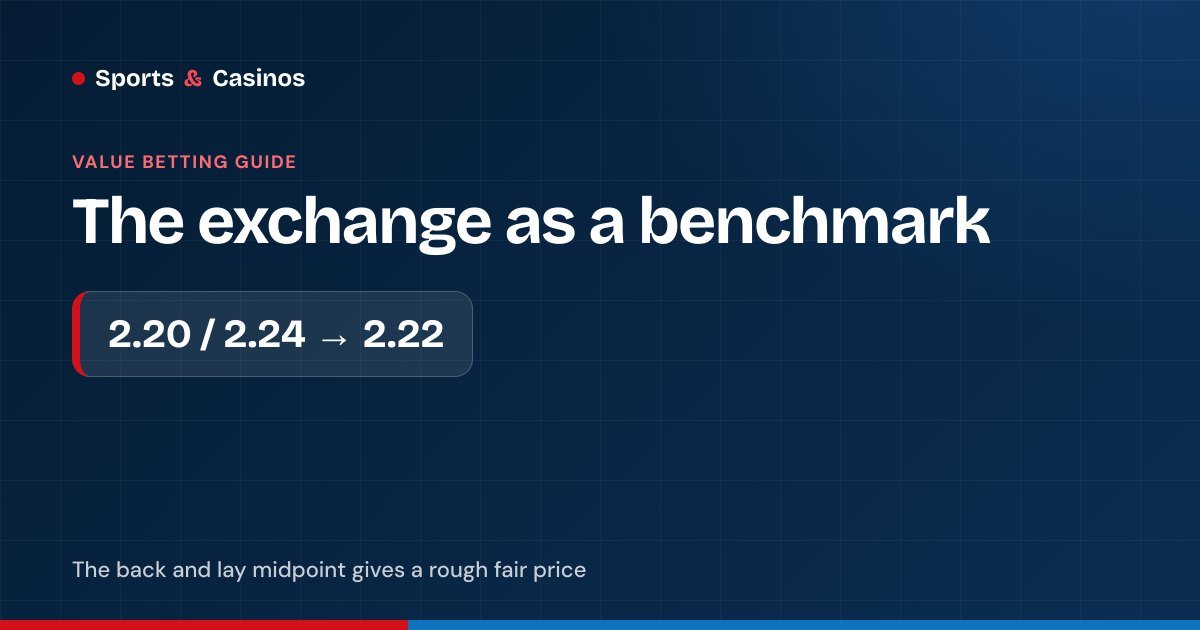
The lay price is always a little higher than the back price. For example, a team might show 2.20 to back and 2.24 to lay. The true price, as the market sees it, sits somewhere in between.
Finding the midpoint
To get a single fair estimate, take the midpoint of the back and lay prices. With 2.20 and 2.24, the midpoint is 2.22. That suggests a fair chance of 1 ÷ 2.22 = 45.0%.
Strictly, it is better to average the two implied chances rather than the odds. Here, 45.45% and 44.64% average to 45.05%, which is still 2.22. So for tight spreads the two ways agree. For wider spreads, though, averaging the chances is the safer choice.
If you’d rather work from a bookmaker’s prices, our guide to fair odds shows how to remove the margin instead. Use the calculator below to check either approach.
Fair odds and margin calculator
Liquidity and when Betfair Exchange prices are less reliable
Liquidity means how much money is waiting to be matched. In a Premier League match there may be lots, so the prices are sharp. But in a lower-league game or a minor market, there may be very little.
Thin markets cause three problems. First, the gap between back and lay gets wide. For example, 3.00 to back and 3.60 to lay implies anything from 27.8% to 33.3%. Second, a single bettor can move the price. Third, prices may lag behind news, such as a late team change. In these cases, treat the midpoint as a rough guide only, and check the amount available at each price.
Also, prices tend to be sharpest close to the start. Early in the week, even a big market can be thinner than it looks. The idea links to closing line value, which compares the odds you took with the final price.
Commission on the Betfair Exchange
Betfair charges commission on your net winnings in each market. The rate can vary, so check the current rate on Betfair before you rely on any figure. Some long-term winning customers can also face extra charges, so it is worth reading the terms.
Commission doesn’t change the midpoint as a benchmark of the true chance. However, it does change the price you’d actually get if you bet on the exchange. To find that effective price, use this sum: 1 + (odds − 1) × (1 − commission rate).
Comparing a bookmaker price with the exchange
There are two questions to ask. First, is the bookmaker’s price above the fair price? Second, is it better than what the exchange would pay you after commission?
Worked example
A team is 2.20 to back and 2.24 to lay on the Betfair Exchange. A bookmaker offers 2.30. We use 5% as an example commission rate only.
- Midpoint: 2.22, a fair chance of about 45.0%.
- Edge at the bookmaker: 2.30 ÷ 2.22 − 1 = 0.036, about 3.6% on paper.
- Effective exchange price: 1 + (2.20 − 1) × 0.95 = 2.14.
- So the bookmaker’s 2.30 is better than the exchange’s 2.14 after commission.
EV check: 0.4505 × 2.30 − 1 = +0.036, or about +36p per £10 staked. That is an average over many bets, not the result of this one.
To see what that edge means in pounds, read our guide to expected value. Remember that a positive edge does not promise a profit. Most bettors lose over time, and even a real edge brings long losing runs. Bookmakers are also legally allowed to limit accounts for commercial reasons, as our page on account restrictions explains.
Related guides
- Fair odds: how to remove the margin
- Sharp bookmakers
- Odds shopping
- Closing line value
- Value betting explained
18+ only. Betting should be fun, and every bet can lose. Set a budget you can afford to lose and stick to it. For free, confidential support, visit BeGambleAware.org or call the National Gambling Helpline on 0808 8020 133.