
Back the favourite is an in-play trade where you back a team that was favourite before kick-off, after it falls behind. Its win price drifts once it concedes. If it then equalises, the price shortens again and you can lay to lock in a result. Without an equaliser, the back bet only pays out if the favourite goes on to win.
This guide explains the steps, gives a worked example, and shows what our half-time data says about favourites that trail.
The short version
- You back a pre-match favourite while it is behind, at a much bigger price.
- An equaliser shortens the price, and you can then lay to green up.
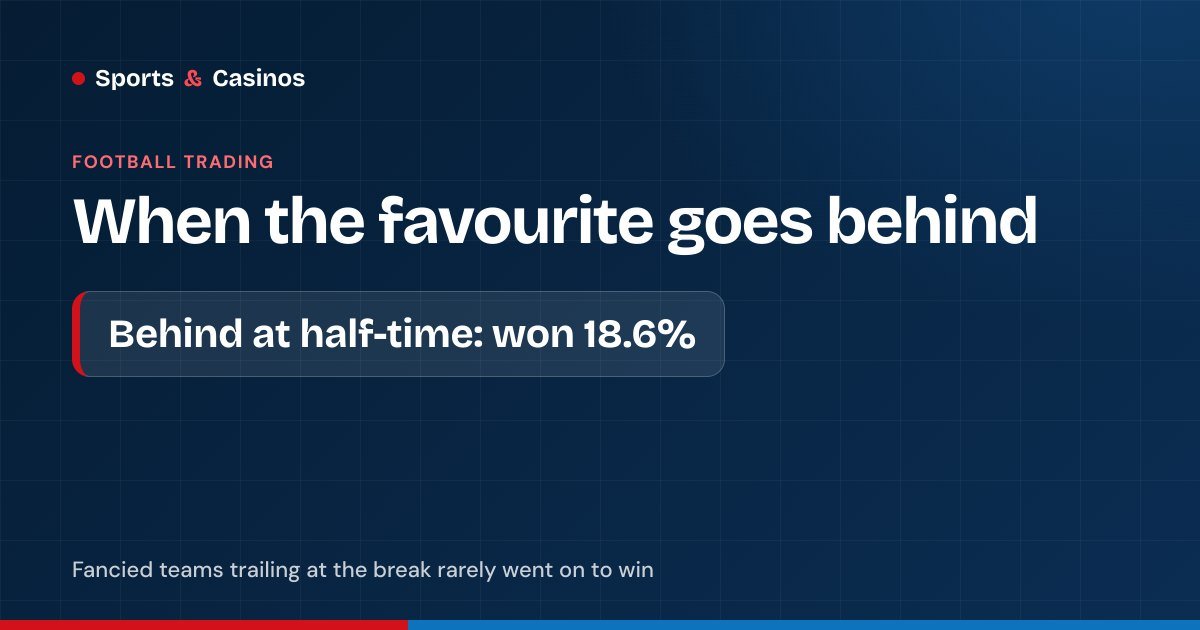
- In our data, favourites priced under 2.0 that trailed at half-time won only 18.6% of the time.
- That is a fair price of about 5.38, which is longer than the 5.0 in our example.
What is back the favourite?
Say a team is 1.70 to win before kick-off but goes 1-0 down. Its win price drifts, perhaps to 5.0 by half-time. The thinking behind this trade is that a stronger side will push for a reply, and an equaliser would cut the price sharply.
So the trade relies on the market overreacting to the goal against. That only helps if it really does overreact. The data further down suggests the market prices this case fairly well. If you are new to back and lay bets, read our guide to the Betfair Exchange first.
How to back the favourite step by step
Read the transcript
Some traders back a strong favourite after it falls behind, looking for a comeback and a shorter price.
We looked at six hundred favourites priced under two that were behind at half-time. Just under one in five went on to win, and nearly half won or drew.
That puts the fair price for the favourite to win at about five point four, so look for a bigger price than that.
Say you back ten pounds at five. If they equalise and the price falls to two point five, lay twenty pounds, and you've locked in ten pounds.
Favourites do come back, and the market prices that in. Please bet responsibly.
- Before the match, note the favourite and its pre-match price.
- If it falls behind, watch the match odds market. Look at how the game is going, not just the score.
- Back the favourite at your chosen stake. First, though, decide your exit plan for both an equaliser and no equaliser.
- If it equalises, lay the favourite at the new, shorter price. Use lay stake = back stake × back odds ÷ lay odds.
- If no equaliser comes, follow the exit plan from step 3, either closing at the current price or letting the bet run.
Back the favourite worked example
Worked example
A team was 1.70 before kick-off but is 1-0 down at half-time, and its win price is 5.0. You back £10 at 5.0. Then it equalises on 65 minutes, and its win price drops to 2.50, so you lay it.
- Lay stake: 10 × 5.0 ÷ 2.50 = £20.00.
- If the favourite wins: the back bet wins £40.00, and the lay pays out 20 × 1.50 = £30.00 from your liability. Net +£10.00.
- If it does not win: the £10.00 back stake is not returned, and the lay wins £20.00. Net +£10.00.
Quick check: 10 × (5.0 ÷ 2.50 − 1) = £10.00, before commission. At 2%, used here as an example rate, that costs 20p, leaving £9.80.
The result is large next to the stake because the risk is large too. As the data shows, a comeback is far from certain. Our guide on how to green up explains the closing sum in more detail.
Liability and suspensions
When you lay, your liability is lay stake × (lay odds − 1). In the example above, that was £30.00, which the £40.00 from the back bet covers if the favourite wins.
Prices can move fast while the favourite is behind. A second goal against, or a red card, can push the price out within seconds. And because in-play markets suspend after big events, you may not be able to close at the price you planned.
What the data says when you back the favourite
We used football-data.co.uk results for 7,149 league matches in 20 European leagues, from 20 October 2025 to 19 October 2026.
- Favourites priced under 2.0 that were behind at half-time (607 matches) won 18.6% and drew 29.0%.
- By contrast, favourites leading at half-time (1,641 matches) went on to win 86.2%.
- Matches level at half-time (2,943) ended as draws 37.6% of the time.
An 18.6% chance gives a fair price of 1 ÷ 0.186, about 5.38. So on average, the 5.0 in our example was shorter than the fair price, and commission comes on top.
There is also a point about timing. Every favourite that drew or won from behind must have equalised at some stage, so at least 47.6% of these games had an equaliser. However, a late equaliser cuts the win price much less than an early one, and the market allows for this. Use the calculator below to test your own price against your own estimate of the chance.
Expected value calculator
Honest limits of this strategy
Backing a trailing favourite feels like buying a strong team cheaply. But the price already reflects the score, the time left and the gap in quality. So the trade only makes sense if you judge the chance better than the market.
These figures are averages over many matches. They describe the market, not a method that wins, and they vary by league and team. So keep stakes small and fixed, and read about betting variance to see why results swing. Our bankroll management guide covers stake sizing. Never raise your stake to chase an earlier result.
Related guides
18+ only. Betting should be fun, and every bet can lose. Set a budget you can afford to lose and stick to it. For free, confidential support, visit BeGambleAware.org or call the National Gambling Helpline on 0808 8020 133.