
Football trading means betting on a match on a betting exchange, then closing that bet at a new price before the result is known. You back or lay a team, a draw or a goals market. Then, as the odds move, you place a second bet to fix your result at the new price.
This guide explains how it works in plain English. It covers backing and laying, liability, commission, liquidity and the in-play delay. It also compares the 7 strategies people use most, and shows what a year of match data says about the markets they use.
The short version
- Football trading uses an exchange, where you can back (bet for) or lay (bet against) an outcome.
- When you lay, your risk is the liability: lay stake × (lay odds − 1).
- Closing a trade at a new price fixes your result, but it does not change the odds in your favour.
- Commission comes off your net winnings, so factor it into every trade.
What is football trading?
A normal bet is simple. You pick an outcome, the match ends, and the bet is settled. Football trading is different, because you plan to leave the bet before the end. So the question is not only “who wins?” but also “where will the price go next?”
For example, a draw might be 3.60 before kick-off. If a goal goes in, the draw price usually drifts out, because a draw is now less likely. A trader who bet against the draw can then close the position for a small amount on every result. If no goal comes, though, the draw gets shorter instead, and closing the position costs more.
Read the transcript
Football trading means backing and laying on a betting exchange, then closing your position before the match ends. Here's how it works.
On an exchange you can back an outcome, or lay it, which means you take the bet like a bookmaker. When you lay, your risk is the liability: the lay stake times the odds, minus one.
Lay ten pounds at three point six, and your liability is twenty-six pounds.
Popular football strategies include laying the draw, laying nil-nil, trading the goals markets, back to lay, and backing the favourite when it falls behind.
The idea is simple. Back at a bigger price, lay at a smaller one, and you lock in a profit whatever the result.
Learn the maths first, keep stakes small, and please bet responsibly.
That is the whole idea. Prices move as the match unfolds, and you trade those moves. However, the market moves for good reasons. Each price already reflects what thousands of other people expect, so being on the right side of a move is hard.
Back and lay: the two sides of an exchange bet
On a bookmaker’s site, you can only back. On an exchange, people bet against each other, so you can also lay. Laying means you act like the bookmaker: you win the other person’s stake if the outcome does not happen, and you pay out if it does.
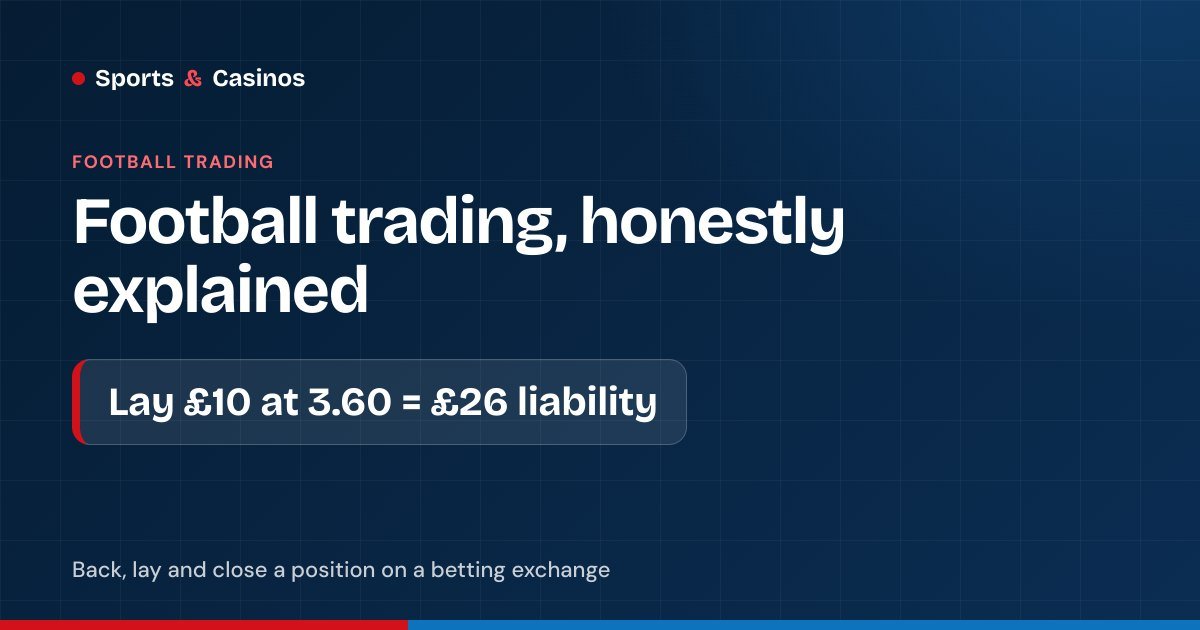
Your risk when you lay is called the liability. The sum is lay stake × (lay odds − 1). So if you lay £10 at 3.60, your liability is £10 × 2.60 = £26. That is the amount you pay out if the outcome happens and you have not closed the trade. Liability grows fast at higher odds, which matters for strategies such as laying 0-0.
Worked example
You lay the draw for £10 at 3.60.
- If the match is not a draw, you win £10, less commission.
- If it is a draw, you pay out £10 × (3.60 − 1) = £26.
- The exchange holds £26 from your balance until the bet settles or you close it.
Our guide to the Betfair Exchange explains back and lay prices in more detail. Also, the betting glossary covers the terms used on this page.
Commission, liquidity and the in-play delay
Commission
Exchanges make their money by charging commission on your net winnings in each market. Rates differ. For example, Smarkets charges 2% and Matchbook about 2%, according to this comparison of betting exchanges. Betfair’s rate can vary, so check the current rate before you rely on any figure.
Commission matters more in trading than in normal betting, because trades are small. At 2%, a £3.45 profit costs about 7p in commission. That sounds tiny, but it is taken from every market where you finish ahead, so it adds up over many trades.
Liquidity
Liquidity means how much money is waiting to be matched at each price. Big leagues often have plenty. In lower leagues, though, the gap between the back and lay price can be wide, and your closing bet may not be matched at the price you want. As a result, a trade that looks fine on paper can cost more to close.
The in-play delay
When a match is live, exchanges hold in-play bets for a few seconds before they go into the market. This protects people from bets placed by someone who has seen a goal first. In practice, it means prices can jump between clicking and matching. So you can never be sure of the exact price you will close at.
How a football trading position is closed
Closing a trade is often called “greening up” when you lock in a profit. You place a second bet at the new price, sized so that your result is the same whatever happens. Our green up guide shows the sums step by step.
There are two versions. If you backed first, your lay stake = back stake × back odds ÷ lay odds. If you laid first, your back stake = lay stake × lay odds ÷ back odds. In both cases, the result is spread equally over every outcome, before commission.
The same sums work whichever way the price has moved. Closing fixes your result at the current price. Holding on leaves the position open, so the final result depends on the match.
Football trading strategies compared
The table below compares the 7 approaches covered in this section. Each one has its own guide with the steps, a worked example and what the data says. None of them is a method for winning; each is just a way to take a view on how a price will move.
| Strategy | What you do | When you profit | Main risk |
|---|---|---|---|
| Green up | Place a second bet to level your result on all outcomes | The price has moved your way since your first bet | Commission and slippage reduce small gains |
| Lay the draw | Lay the draw before kick-off, back it after a goal | A goal comes early and the draw drifts | No goal: the draw shortens and closing costs more |
| Lay 0-0 | Lay the 0-0 correct score | Any goal is scored | Large liability if the match stays 0-0 |
| Back to lay | Back at one price, lay at a shorter one | The price shortens | The price drifts out instead |
| Under 2.5 trading | Back under 2.5 goals, lay it later | Time passes with few or no goals | An early goal makes the under drift |
| Over 2.5 trading | Back over 2.5 goals, lay it after a goal | A goal comes early | A quiet first hour makes the over drift |
| Back the favourite | Back a favourite, often in-play when it falls behind | The favourite recovers or its price shortens | Favourites behind at half-time often do not recover |
Notice the pattern. Every strategy depends on the match going one particular way. The market already prices both paths, so the strategy name alone tells you nothing about whether a trade is good value.
What the data says about football trading
We looked at 7,149 league matches in 20 European leagues, from 20 October 2025 to 19 October 2026, using results from football-data.co.uk. These figures describe the market. They are not a strategy that wins.
- Draws: 25.8% of matches. 0-0 at full time: 6.8%.
- 0-0 at half-time: 29.0%. A goal in the first half: 71.0%.
- Over 2.5 goals: 53.5%, with an average of 2.77 goals a match.
- Favourites priced under 2.0 that were behind at half-time won only 18.6% of the time.
We also compared Betfair Exchange prices days before kick-off with prices at kick-off, over more than 6,500 matches. The match odds book had a 2.8% margin early, against 0.9% at kick-off. That means early prices are less accurate, but not in a way that is easy to use.
Prices also drifted out more often than they shortened between those two points. So a trader who backs early and hopes to lay at a shorter price is working against the most common direction of movement.
The honest limits of football trading
Football trading is often sold as a skill that turns betting into something safer. However, closing a trade early does not change the maths. Each bet you place is still made at the market’s price, and commission is taken from every market where you finish ahead.
So any long-run profit needs better judgement or better information than the market. Results also swing a lot from week to week. Our guide to betting variance shows how wide those swings can be.
There are other practical limits too:
- In-play prices move in seconds, so it is easy to react on impulse.
- Small, frequent trades can make it hard to see how much you have staked in total.
- Liability on lays can be many times your stake.
- Thin markets can leave you unable to close at a fair price.
If you do try football trading, keep stakes small, set a fixed budget and keep a record. Our page on bankroll management explains how to size stakes so that each trade stays well inside that budget. Never raise your stakes to make up for an earlier trade.
Tools for checking a football trading price
Trading is about price, so it helps to know what a price means. The odds converter turns any price into an implied chance, and the expected value calculator shows whether a price looks fair against your own estimate. You can also check a single price with the calculator below.
Odds converter
For goals markets, our free Value Predictor shows how often each team has hit first-half goals, over 1.5 and over 2.5 in recent games. Its output is statistics, not tips. Then, if you prefer to stake in small steps during a match, the drip feed calculator can help you plan each step.
All football trading guides
Each guide below covers one strategy in depth, with the steps, a worked example, the liability and the data.
Related guides
- Betfair Exchange prices as a benchmark
- Closing line value
- Betting variance
- Drip feeding in-play bets
- Value betting explained
18+ only. Betting should be fun, and every bet can lose. Set a budget you can afford to lose and stick to it. For free, confidential support, visit BeGambleAware.org or call the National Gambling Helpline on 0808 8020 133.