
An over 2.5 goals bet wins if the match ends with 3 or more goals. It is one of the most popular football markets in the UK, and it is also one of the easiest to price yourself with a little maths.
This guide shows you how to turn an expected goals figure into a fair price, how to spot when the odds on offer look too short or too long, and where the simple model breaks down.
The short version
- Over 2.5 goals means 3 or more goals in the match. Extra time does not count.
- A Poisson model turns expected total goals into a chance for 0, 1 and 2 goals. Take those from 100% and you have the chance of the over.
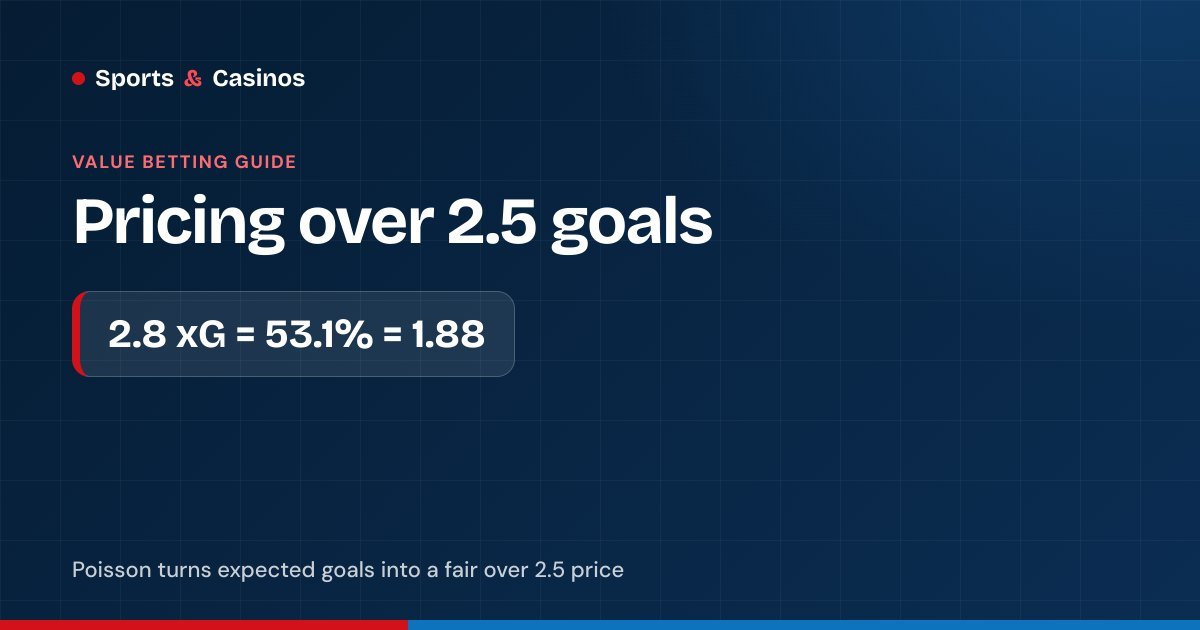
- With 2.8 expected goals, the chance is about 53.1%, so fair odds are about 1.88.
- Our Value Predictor’s 70% rule is a filter for busy matches. It is not a probability, so treat its hit rates with care.
How over 2.5 goals odds work
Every price hides a chance. Odds of 1.88 imply a 53.2% chance, because 1 ÷ 1.88 = 0.532. If you want to check any price quickly, our guide to implied probability walks through it.
The bookmaker’s price also carries a margin. So the over and under prices together add up to more than 100%. To judge value, you need your own estimate of the chance. Then you compare it with the price. In short, the aim is to judge the price, not to guess the score.
A simple Poisson model for over 2.5 goals
The Poisson distribution is a standard way to model how often a rare event happens in a fixed time. Goals in football fit it fairly well. The only input it needs is the average, which here is the expected total goals in the match. You can read more about the maths on Wikipedia’s Poisson distribution page.
The formula for the chance of exactly k goals is P(k) = λk × e−λ ÷ k!. Here λ (lambda) is the expected total goals. Next, you work out P(0), P(1) and P(2). Finally, you take their sum away from 100%.
Where the expected goals figure comes from
You can build λ from each team’s expected goals (xG) for and against, adjusted for home and away. For example, a home side expected to score 1.6 and an away side expected to score 1.2 gives λ = 2.8. Many bettors also back out λ from the market itself. That gives you a sense check on your own number.
Worked example
Say your model expects 2.8 total goals in a match. Here is what Poisson says:
| Total goals | Sum | Chance |
|---|---|---|
| 0 goals | e−2.8 | 6.08% |
| 1 goal | 2.8 × e−2.8 | 17.03% |
| 2 goals | (2.8² ÷ 2) × e−2.8 | 23.84% |
| Under 2.5 (0 to 2) | Total of the above | 46.95% |
| Over 2.5 (3 or more) | 100% − 46.95% | 53.05% |
So the chance of over 2.5 goals is about 53.1%. Fair odds are 1 ÷ 0.5305 = 1.88 (about 22/25). If a bookmaker offers 2.00, the expected value per £1 is 0.5305 × 2.00 − 1 = +£0.06. At 1.80, it is 0.5305 × 1.80 − 1 = −£0.045, so that price is too short for your estimate.
Use the calculator below to test your own numbers. Enter your stake, the odds and your chance, and it shows the expected value and your edge.
Expected value calculator
For more on how this maths works, see our guide to expected value betting. Also, our page on fair odds shows how to strip the margin from a price.
The limits of Poisson for over 2.5 goals
Poisson is a good first step, but it makes some big assumptions. It treats every goal as independent, and it assumes the scoring rate stays the same for 90 minutes. Real matches do not behave like that. So here are the main gaps.
Draws and low scores
When you model each team separately, basic Poisson tends to under-count 0-0 and 1-1 draws. That matters, because those are both unders. As a result, a plain model can make the over look a little more likely than it is. The Dixon-Coles adjustment is one well-known fix for low scores.
Game state
Teams change how they play once the score changes. A side that leads 1-0 may sit deep, while a side that trails takes more risks. Also, red cards, injuries and late subs shift the rate of goals. Poisson ignores all of this, so goals tend to be more spread out than the model says.
Your input is the weak point
Finally, the model is only as good as λ. If your expected goals figure is off by 0.3, the chance can move by several points. For example, λ = 2.5 gives about 45.6% for the over, not 53.1%. That is a big gap, so be honest about how sure you are.
Reading the Value Predictor’s over 2.5 goals rule
Our free Value Predictor flags a match for this market when each team went over 2.5 in at least 70% of its last games, with an average of 3.0 or more goals. That rule is a filter. It finds matches between teams whose recent games were busy. However, it does not tell you the chance that this match goes over.
There are three reasons. First, each team’s games were against different opponents. Second, a run of 10 games is a small sample, so 7 out of 10 could easily be a 55% team on a good run. Third, the market already knows these teams score and concede a lot, so the price will often be short.
Turning a hit rate into a rough fair price
One simple fix is to pull the hit rate back towards the league average. That way, a short hot streak does not count for too much. With 5 to 10 games of data, a 50/50 blend is a fair rough guide.
Worked example
With the Value Predictor set to 10 games, both teams went over 2.5 goals in 70% of them. Say the league rate this season is 52%. Then the blend is (0.5 × 70%) + (0.5 × 52%) = 61%. So a rough fair price is 1 ÷ 0.61 = 1.64.
If the best odds on offer are 1.57, that is shorter than your fair price, so there is no value. But if they are 1.75, the price may be worth a closer look. Even then, check it against a model like the one above.
Treat this as a quick sense check, not a precise number. The Value Predictor shows statistics, not tips. You can also see how its rules have done over time on the Value Predictor track record page.
Using over 2.5 goals prices with care
Even when your estimate is good, most single bets on this market are close to a coin flip. So you will see long losing runs, and a real edge only shows over hundreds of bets. That means you should keep records and stakes small. Our guide to betting variance shows how big those swings can be. Value betting is a way to judge prices. It does not promise a profit, and most people who bet lose over time.
Related guides
- Value betting explained
- First half goals: how to price the market
- Closing line value
- Bankroll management
18+ only. Betting should be fun, and every bet can lose. Set a budget you can afford to lose and stick to it. For free, confidential support, visit BeGambleAware.org or call the National Gambling Helpline on 0808 8020 133.