
A first half goals bet, in its most common form, wins if at least one goal is scored before half time. Bookmakers list it as “over 0.5 first half goals” or “goal in the first half”. It sounds simple, and the maths behind it is simple too.
This guide explains why first halves are quieter, how to turn expected goals into a fair price, and why our Value Predictor no longer covers this market.
The short version
- Over 0.5 first half goals wins if anyone scores before the half-time whistle, including added time.
- Across top leagues, roughly 44% to 46% of goals come in the first half.
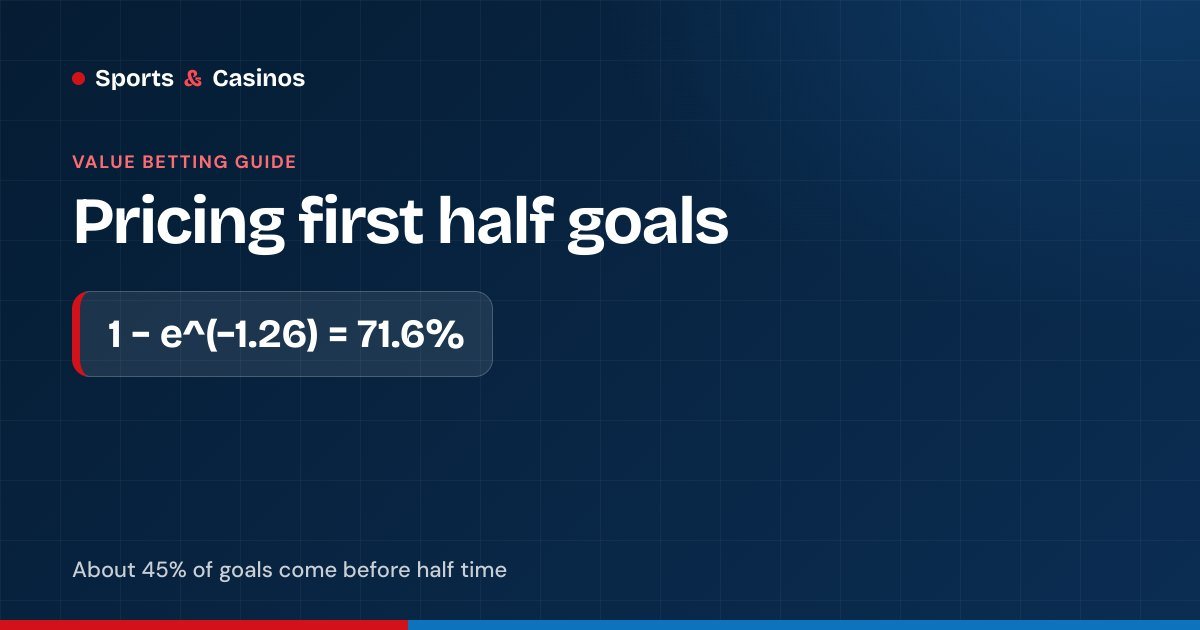
- The chance of at least one first half goal is 1 − e−λ, where λ is the expected first half goals.
- With 2.8 expected goals in the match, that is about 71.6%, so fair odds are about 1.40.
How the first half goals market works
The over 0.5 line needs just one goal from either side by half time. Stoppage time at the end of the first half counts. However, a goal in the second half does not, even in the 46th minute. Some bookmakers also offer over 1.5 first half goals, or a goal for a named team, but this guide sticks to the main line.
Because one goal is enough, the odds are usually short, often between 1.30 and 1.50. So small changes in the price make a big difference to value. For example, 1.33 implies 75.2%, while 1.44 implies 69.4%. Our guide to implied probability shows how to do these sums.
Why first halves have fewer goals
Goals are not spread evenly across a match. A study of the Premier League, La Liga, Serie A and Ligue 1 over three seasons found 44.9% of goals came in the first half and 55.1% in the second (Alberti and others, Sport Sciences for Health, 2013). Figures vary a little by league and season, so roughly 44% to 46% is a fair working range. That makes 45% a handy round number.
There are a few likely reasons. First, players tire in the second half, so defences make more mistakes. Second, a team that is behind must chase the game, which opens it up. Also, coaches make attacking subs late on. Finally, second halves tend to have more added time.
How to price first half goals
You need one number: λ, the expected goals in the first half. A simple way to get it is to take your expected total goals for the match and multiply by 0.45. Then use the Poisson formula for zero goals, which is e−λ. The chance of at least one goal is everything else, so P = 1 − e−λ.
Worked example
Your model expects 2.8 goals in the match. So the first half share is 2.8 × 0.45 = 1.26 goals.
- Chance of no first half goal: e−1.26 = 28.4%
- Chance of at least one: 100% − 28.4% = 71.6%
- Fair odds: 1 ÷ 0.716 = 1.40 (2/5)
Now compare prices. At 1.44, the expected value per £1 is 0.716 × 1.44 − 1 = +£0.03. At 1.33, it is 0.716 × 1.33 − 1 = −£0.05. That means 1.33 is too short for your estimate, while 1.44 looks like value.
Use the calculator below to check any price. Enter your stake, the odds and your chance, and it shows the expected value and edge.
Expected value calculator
How sensitive is the first half goals price?
The answer moves quite a lot with your inputs. Here is how the chance changes with the expected total goals, using a 45% first half share:
| Expected total goals | First half λ | Chance of a goal | Fair odds |
|---|---|---|---|
| 2.5 | 1.13 | 67.5% | 1.48 |
| 2.8 | 1.26 | 71.6% | 1.40 |
| 3.2 | 1.44 | 76.3% | 1.31 |
If you use 44% or 46% instead of 45%, the chance at 2.8 goals moves by under 1 point. Your total goals figure matters much more than the split. For more on how to build and test a fair price, see our guide to fair odds.
Limits of the model
Poisson assumes goals arrive at a steady rate. In truth, the early minutes are often cagey, and a team that scores early may then slow down. Also, some matchups are tight in the first half by design, such as a cup tie where neither side wants to concede. So treat the model as a starting point, then adjust for what you know.
Why our Value Predictor no longer covers first half goals
Our free Value Predictor used to list matches for a first half goal. We dropped the market, because the prices are usually too short to offer value.
Worked example
Over the last year, the first half goals picks were typically priced at about 1.29. That price only makes sense if the bet lands 1 ÷ 1.29 = 77.5% of the time. The picks landed 73.2%. So the form was good, but the price was already shorter than the chance.
At prices that short, there is very little room for one bookmaker to be bigger than the real chance. The Value Predictor now covers over and under 2.5, both teams to score, match result and Asian handicap instead. Our guide to the betting markets we cover explains why. You can still use the method in this guide to price first half goals yourself.
First half goals and losing runs
Short odds feel safe, but they are not. At 71.6%, you would expect a losing bet about 1 time in 4, and losing runs of 3 or 4 in a row will happen. Even a real edge on first half goals is thin, so it only shows over many bets. Value betting helps you judge a price. It does not promise a profit, and most people who bet lose over time.
Related guides
- Drip feeding bets in-play: the maths
- Over 2.5 goals: how to price the market
- Expected value betting
- Betting variance
- Value betting explained
18+ only. Betting should be fun, and every bet can lose. Set a budget you can afford to lose and stick to it. For free, confidential support, visit BeGambleAware.org or call the National Gambling Helpline on 0808 8020 133.