
Value betting myths spread fast because the idea sounds simple. Bet when the price is too big, and you win in the end. But the details are where most people go wrong.
Below, we take 7 common beliefs and check each one against the maths. Each myth comes with the fact that replaces it, plus real numbers where they help.
The short version
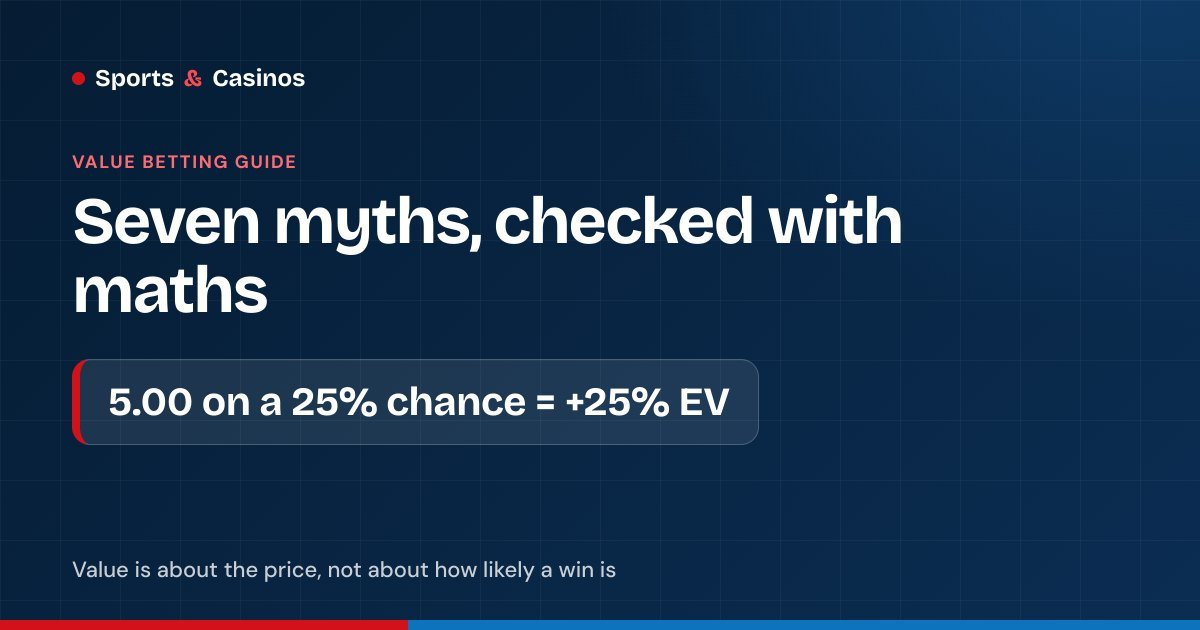
- Value is about the price, not about how likely a win is.
- A value bet is a good price, not a prediction.
- Big odds are not value on their own.
- Short-term profit proves very little.
- No method can promise a profit.
Value betting myths about winning
Myth 1: “Value means likely to win”
Fact: value compares the price with the true chance. It says nothing about whether a bet is likely to win. So a longshot can be value, and a strong favourite can be poor value.
Worked example
- An outsider at 5.00 (4/1) that truly wins 25% of the time has an EV of 0.25 × 5.00 − 1 = +0.25, or +25p per £1.
- A favourite at 1.40 (2/5) implies 71.4%. If its true chance is 68%, the EV is 0.68 × 1.40 − 1 = −0.048.
The favourite wins far more often, but the outsider is the value bet. However, it still only wins 1 time in 4.
Our guide to implied probability shows how to turn any price into a percentage, so you can make this comparison yourself.
Myth 2: “A value bet should win”
Fact: a value bet is a good price, not a prediction. Think of a fair coin offered at 2.20 on heads. That is clear value, because the fair price is 2.00. Even so, it only wins half the time.
So when a value bet doesn’t win, it doesn’t mean you were wrong. One result tells you almost nothing. Instead, judge your bets by the price you got, which we come back to below.
Myth 3: “You need to win most bets”
Fact: what matters is your win rate compared with the odds. At 2.50, you only need to win more than 40% of the time to come out ahead in the long run. That means you can win fewer than half your bets and still have an edge.
For example, with a true chance of 43% at 2.50, you win 43 bets in every 100 on average. Yet the EV is still +7.5%. This is why a high strike rate on its own is no sign of skill. Someone who backs short favourites can win 7 bets in 10 and still be down overall.
Value betting myths about odds and bookmakers
Myth 4: “High odds = value”
Fact: big odds just mean a small chance. They are only value if the chance is bigger than the odds suggest. For example, a horse at 10.00 implies 10%. If its true chance is 8%, the EV is 0.08 × 10.00 − 1 = −0.20, or 20p down per £1.
Also, studies of racing markets have long found that longshots tend to offer worse value than favourites. This pattern is called the favourite-longshot bias. So big prices often carry more margin, not less. Our guide to fair odds shows how to strip the margin out of a market.
Myth 5: “Bookies always get it right”
Fact: bookmakers set prices well, but not perfectly. Their odds are estimates, and they move as news and money arrive. As a result, different firms often quote different prices on the same event, for example 2.30 at one and 2.50 at another.
Even so, this myth has a true core. Prices in big markets close to kick-off are hard to beat, because they reflect a lot of information. That’s why the closing price makes such a useful test. Our page on sharp bookmakers explains which prices tend to be most accurate.
Value betting myths about results and profit
Myth 6: “Short-term results prove skill”
Fact: luck dominates small samples. Imagine 100 bets at 2.00 on true 50/50 chances, with no edge at all. Even so, there is about an 18% chance of ending at least 10 points up. That is nearly 1 in 5 people with no skill who will look skilled.
The reverse is true too. A real edge can still show no profit after 100 or even 500 bets. So a better early test is closing line value: whether you beat the final price. You can see how much results swing with the calculator below. Set an edge and a number of bets, then run it a few times.
Variance simulator
Our guides to betting variance and closing line value go into more detail.
Myth 7: “Value betting guarantees profit”
Fact: nothing can promise a profit. Your estimates can be wrong.
There is also a practical limit in the UK. Bookmakers can legally restrict accounts for commercial reasons. A 2025 Gambling Commission review found that 4.31% of about 15 million active accounts had some restriction in 2024. Restricted customers were also far more likely to be in profit: 46.78%, against 25.42% of all active customers.
So treat value betting as a way to judge prices, not as a way to earn. Our guide to betting account restrictions explains the rules in plain terms.
How to test value betting myths yourself
The best defence against myths is a clear record. First, write down the odds you took and your own probability before each bet. Then add the closing odds and the result. After a few hundred bets, you can check your CLV and your yield against the maths.
Our betting records guide shows what to track. And if you are new to the topic, start with value betting explained.
Finally, set a budget you can afford to lose before you start, and stick to it. If you ever feel the urge to chase losses, take a break.
Related guides
- Value betting explained: the UK guide
- Expected value betting
- Bankroll management
- Value betting vs matched betting
18+ only. Betting should be fun, and every bet can lose. Set a budget you can afford to lose and stick to it. For free, confidential support, visit BeGambleAware.org or call the National Gambling Helpline on 0808 8020 133.