
Financial risk checks are coming to UK betting. The Gambling Commission calls them financial risk assessments. They are light-touch checks that use credit reference data when a customer’s net deposits pass a set level.
This guide explains the staged rollout, the thresholds, how your data is used and what it means if you bet regularly. It draws on the Commission’s update of 7 July 2026.
The short version
- Financial risk checks start when net deposits pass a threshold, and they roll out in stages.
- Stage 1 covers the largest operators, with a trigger of £5,000 in 24 hours for over-25s, or £2,500 for under-25s.
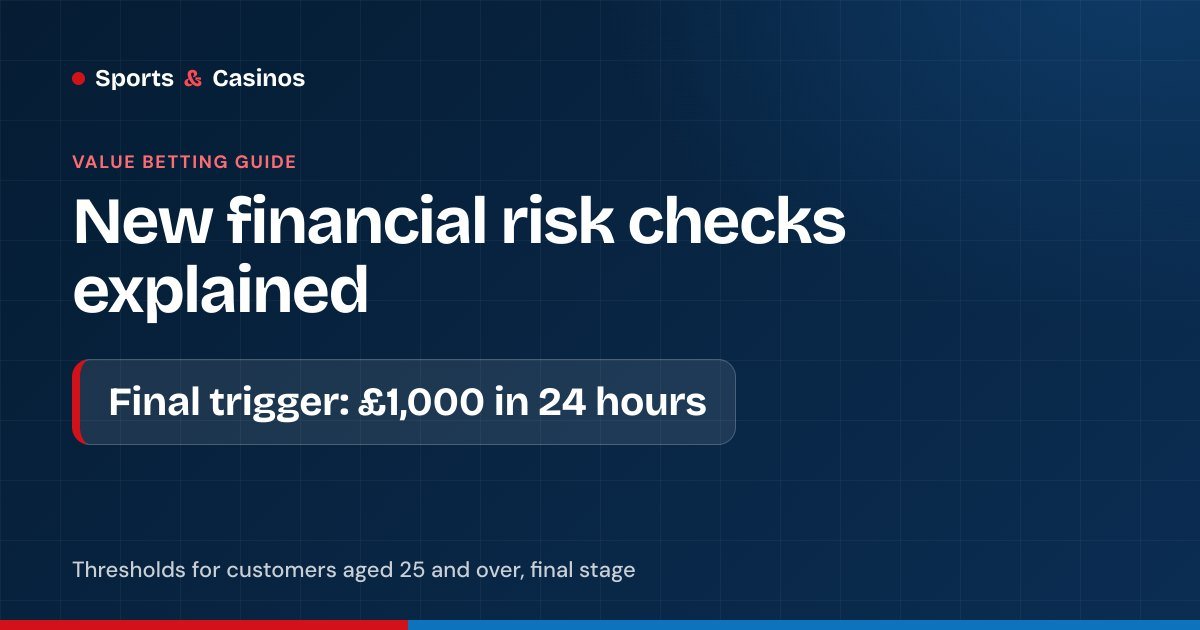
- The final stage triggers at £1,000 in 24 hours or £3,000 in 90 days (over-25s).
- The checks use credit data, have no effect on your credit score, and about 97% will be frictionless.
- Being flagged does not mean your account is restricted automatically.
- The Stage 1 start date is not yet fixed.
What are financial risk checks?
A financial risk check looks for signs that a customer may be in financial difficulty. Instead of asking you for payslips, the operator gets a summary from credit reference data in the background. So most people won’t notice anything at all.
The aim is to spot serious money trouble early, at the point where someone is spending heavily. The Commission says operators must only use the data for regulatory purposes, not commercial ones.
The stages and thresholds
The rules arrive in stages. First, Stage 1 covers the largest operators only. Then interim stages follow, and the Commission has yet to set their thresholds. Finally, the full thresholds apply. All figures below are net deposits, which means money paid in minus money withdrawn.
| Stage | Aged 25 and over | Aged under 25 |
|---|---|---|
| Stage 1 | Over £5,000 in a rolling 24 hours | Over £2,500 in a rolling 24 hours |
| Interim stages | Not yet set | Not yet set |
| Final stage | Over £1,000 in 24 hours, or over £3,000 in a rolling 90 days | Over £750 in 24 hours, or over £2,000 in a rolling 90 days |
For context, fewer than 0.5% of customers deposit over £5,000 in 24 hours. Even once the final stage applies, the Commission expects fewer than 3% of accounts to need an assessment.
Worked example
Sam is 32. On Friday at 7pm, Sam deposits £700. On Saturday at 11am, Sam deposits £400 and withdraws nothing. That is £1,100 in net deposits within 24 hours.
Under Stage 1, nothing happens, because £1,100 is well below £5,000. Under the final rules, however, £1,100 is over £1,000, so a financial risk check would apply.
Now take Alex, also over 25, who deposits £260 a week for 12 weeks. That is £3,120 in 84 days, which passes the £3,000 limit for 90 days. So a check would apply under the final rules too.
When will financial risk checks start?
The Stage 1 start date is not yet fixed. As of the July 2026 update, the Commission said it would confirm the date in its formal response to the consultation. So please check the Gambling Commission’s update and its news pages for the latest position. We also track changes on our UK gambling rule changes page.
How credit data is used
When a check runs, the operator gets an overall risk result plus four data points from credit reference data:
- defaults
- multiple arrears
- significant arrears
- whether you have a Debt Management Plan
Importantly, these checks have no effect on your credit score. Lenders won’t see them as a credit application. Also, about 97% of the checks that do run will be frictionless, which means you won’t need to send any documents.
Being flagged is not an automatic restriction
If a check flags a risk, the operator does not have to restrict your account automatically. Instead, it should respond in a way that fits the person. For example, it might reduce marketing or offer support to set deposit limits.
In the early stages, the Commission also said it won’t take enforcement action against operators that fail to act after an assessment, as long as they meet existing rules. That gives firms time to learn how the checks work in practice.
Financial risk checks vs affordability documents
Many bettors worry about being asked for bank statements or payslips. That is a different thing. Document checks ask you to prove your income or savings, often after a firm has concerns. By contrast, financial risk checks run in the background on credit data, and for nearly everyone they need no paperwork.
A very small group, fewer than 1 in 1,000 accounts, may need a check that a firm can’t complete frictionlessly. In that case, a firm may ask for identity checks, open banking or documents. Separately, firms still have their own duties to look out for signs of harm, so other checks can still happen.
What it means for regular bettors
If you bet small amounts within a budget, you are unlikely to notice any change. However, if your deposits are large or frequent, a check becomes more likely as the thresholds come down. So it helps to know your own numbers.
- Track your deposits and withdrawals. Our guide to betting records shows a simple way to do it.
- Use deposit limits. Every licensed operator offers them, and they keep spending in line with your plan.
- Size stakes sensibly. Our bankroll management guide explains why stakes should be small next to your budget.
Note that these checks are about financial risk, not about whether you win. They are a separate issue from betting account restrictions, which firms apply for commercial reasons.
An honest view
Financial risk checks aim to protect people who are spending more than they can afford. If a check raises a concern about you, take it seriously. Betting should never be a way to fix money problems, and most bettors lose over time. So set a budget you can afford to lose, and get free support early if betting stops being fun.
Related guides
18+ only. Betting should be fun, and every bet can lose. Set a budget you can afford to lose and stick to it. For free, confidential support, visit BeGambleAware.org or call the National Gambling Helpline on 0808 8020 133.