
Sharp bookmakers are firms that set their own prices, take big bets and move their odds quickly when sharp money arrives. Soft bookmakers tend to follow the market instead. So if you want to judge whether a price is good, you need to know which kind of firm you are looking at.
This guide explains the difference in plain English. It covers margins, limits and how prices move, and why the sharpest prices make the best yardstick for value.
The short version
- Sharp bookmakers make their own prices, run low margins and welcome winning customers.
- Soft bookmakers usually run higher margins, lean on the wider market for prices and may limit stakes.
- Sharp prices are the closest thing to a fair price, so they make a good benchmark.
- Pinnacle is not available in the UK, so UK bettors often use the Betfair Exchange as their reference.
- A benchmark helps you judge prices. It does not promise profit.
What are sharp bookmakers?
A sharp bookmaker is a price maker. It employs traders and models to build its own odds, then lets the bets it takes tell it where the price should be. For example, if large, well-informed bets keep landing on one side, it shortens that side fast.
Because the firm learns from its customers, it is happy to take bets from winners. Their stakes are useful information. As a result, sharp bookmakers can offer low margins and high limits, and their prices tend to settle close to the true chance of each outcome.
What are soft bookmakers?
A soft bookmaker earns most of its money from customers who bet for fun. It often takes prices from the wider market, then adds its own margin and offers on top. That is a business choice, not a flaw, and many soft firms run large, well-known brands.
However, a firm that copies the market can be slow to react. If team news breaks and the sharp price moves, a soft price may lag for a few minutes. Also, soft firms may price popular markets with extra margin and use promotions to win new customers. We don’t label any named bookmaker as soft here, because each firm’s model changes over time and differs by sport.
Margins: sharp vs soft bookmakers
The margin, or overround, is the extra the bookmaker builds into its prices. You find it by adding up the implied probability of every outcome and taking away 100%. Our guide to implied probability shows the full method.
Worked example
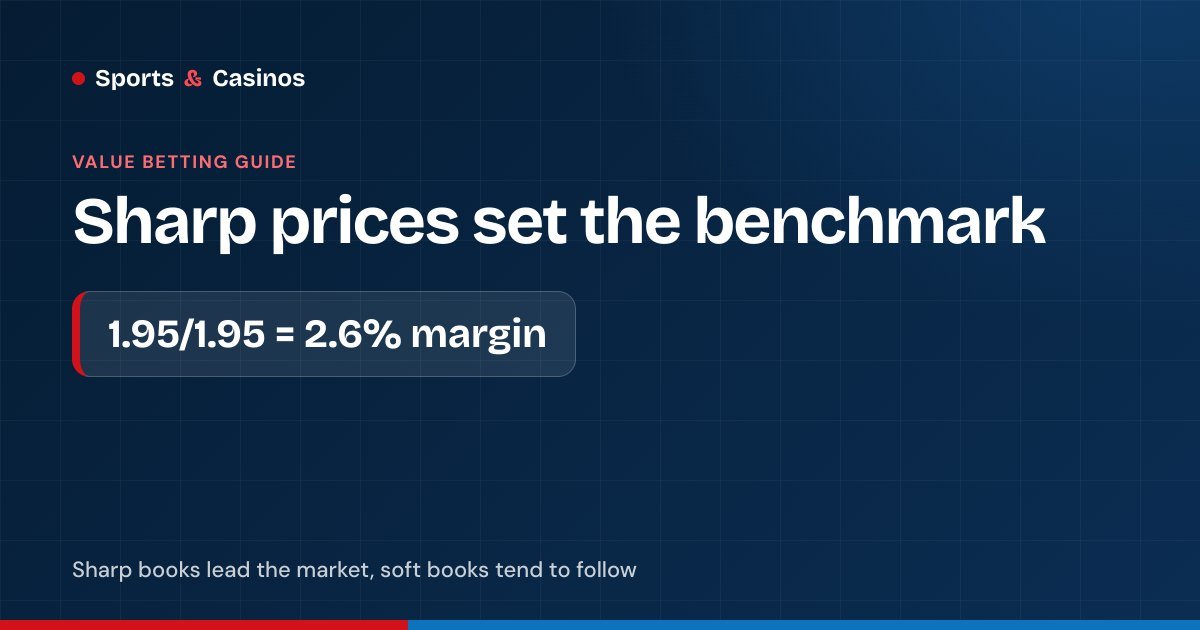
Take a two-way tennis match. Book A offers 1.95 and 1.95. Each price implies 1 ÷ 1.95 = 51.28%, so the total is 102.56% and the margin is about 2.6%.
Book B offers 1.87 and 1.87. Each price implies 53.48%, so the total is 106.95% and the margin is about 7%. Same match, same chances, but Book B keeps far more of every pound staked over time.
Low margins are typical of sharp bookmakers on major markets. By contrast, soft firms often sit higher, mostly on less popular markets and accumulators. Use the calculator below to check the margin and fair odds on any 2 or 3-way market you see.
Fair odds and margin calculator
Limits and account restrictions
Sharp bookmakers usually accept large stakes and rarely limit winners. In fact, their model depends on taking those bets. Soft bookmakers tend to manage risk differently. They may cut the maximum stake on an account, remove offers or close an account for commercial reasons.
This is legal in Great Britain. Bookmakers can make commercial decisions about who they serve, as long as they don’t discriminate on protected grounds. Our guide to betting account restrictions covers the regulator’s data and what you can expect.
How prices move
Odds are not fixed. They open, they move as money and news arrive, and then they close when the event starts. Sharp bookmakers lead this process. First, they open with a low limit while the price is still rough. Next, they raise limits as bets refine the line. Finally, by kick-off, the price reflects a huge amount of information.
Soft prices tend to follow those moves, often with a short delay. That delay is one reason a soft price can sometimes sit above the sharp price for a while. It is also why the closing sharp price is such a useful test. Our guide to closing line value explains how to compare the odds you took with the final price.
Why sharp bookmakers make a good benchmark
If you want to know whether a price is value, you need an estimate of the true chance. Building your own model is hard. Instead, many bettors use sharp prices as a shortcut, because those prices have low margins and plenty of informed money behind them.
The idea is simple. First, strip the margin from the sharp price to get a fair price. Then compare that fair price with the odds on offer elsewhere. If the odds you can get are longer than the fair price, the bet may have positive expected value. Our fair odds guide and expected value guide walk through both steps.
Worked example
A sharp market shows 2.04 and 1.92 on a two-way match. The implied chances are 49.02% and 52.08%, a total of 101.10%. So the fair chance of the first side is 49.02 ÷ 101.10 = 48.49%, which is fair odds of about 2.06.
Another firm offers 2.20 on that side. Your EV per £1 is 0.4849 × 2.20 − 1 = about 0.067, or 6.7p per £1 staked on average. That is an estimate, not a promise, and any single bet still either wins or doesn’t.
Even so, sharp prices are not perfect. They can be wrong, mostly early in the week or on small markets with little money behind them. Treat them as the best guide you have, not as the truth.
Sharp bookmakers and UK bettors: Pinnacle and Betfair
Pinnacle is the firm most people mean when they talk about sharp bookmakers. However, it left the UK market in 2014 and later withdrew its licence application, as iGaming Business reported in 2018. So it is not available to UK customers, and you should only bet with firms licensed by the Gambling Commission.
Instead, UK bettors often use the Betfair Exchange as their reference. On an exchange, customers bet against each other, so the price comes from the crowd rather than one trader. On busy markets with plenty of money matched, the gap between back and lay prices is small, and the midpoint is a fair estimate of the true chance.
Bear in mind that Betfair charges commission on net winnings in each market. So check the current rate, and allow for it when you compare prices. Our Betfair Exchange guide covers this in more detail.
Honest limits
Knowing the difference between sharp bookmakers and soft ones helps you judge prices. It does not turn betting into a source of income. Also, if you find value often, a soft firm may limit your account. So treat value betting as a way to bet more thoughtfully, set a budget, and only stake what you can afford to lose.
Related guides
- Value betting explained
- Odds shopping: what the best price is worth
- Bookmaker margin vs house edge
- Betting variance
18+ only. Betting should be fun, and every bet can lose. Set a budget you can afford to lose and stick to it. For free, confidential support, visit BeGambleAware.org or call the National Gambling Helpline on 0808 8020 133.