
To lay 0-0 means betting on an exchange that a football match will not end goalless. You take the other side of a 0-0 correct score bet. So if anyone scores, you win the backer’s stake. But if the match ends 0-0, you pay out at the full odds, which can be many times your stake.
This guide explains the steps, the liability and the sums behind the trade. It also shows what a year of match data says about goalless games.
The short version
- You win your lay stake if any goal is scored, less commission.
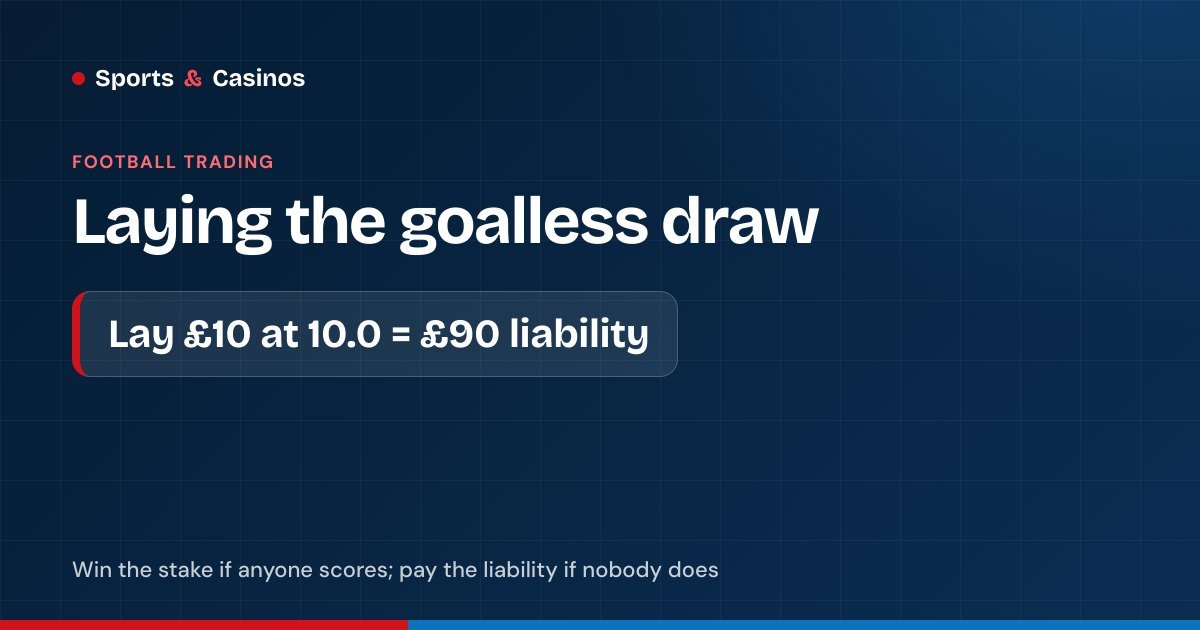
- Your liability is lay stake × (lay odds − 1), so £10 at 10.0 risks £90.
- In our data, 6.8% of matches ended 0-0. The price already reflects that.
- A high win rate does not mean a good bet: the liability is many times the stake.
What does it mean to lay 0-0?
The correct score market lists every likely scoreline, with 0-0 as one option. Backing 0-0 means betting the match ends goalless. Laying it means betting the opposite, so any other score is a win for you.
Read the transcript
Laying nil-nil in the correct score market is a simple trade. Any goal, and the bet is won.
Lay ten pounds at ten, and your liability is ninety pounds. That's the amount you need in your account to place the bet.
As soon as anyone scores, nil-nil can't happen, so your lay wins ten pounds, less commission.
Only six point eight per cent of matches ended nil-nil. Seven in ten had a first-half goal, which settles the trade early. The market already prices low-scoring games shorter, so choose your matches with care.
Laying nil-nil is settled the moment anyone scores. Size your stakes for the liability, and please bet responsibly.
The appeal is easy to see. Most matches have at least one goal, so the bet wins most of the time. However, the 0-0 is usually a long price, and the liability grows with the price. That is why the wins are small and the liability is large. For the basics of laying and liability, see our football trading guide.
How the trade works step by step
- Find the 0-0 in the correct score market on an exchange, and check the price and how much money is available.
- Work out the liability: lay stake × (lay odds − 1). Only go ahead if the full liability fits inside your budget.
- Lay the 0-0, usually before kick-off.
- If a goal goes in, the 0-0 can no longer happen, so the bet is settled as a win. There is nothing more to do.
- Set a time in advance to close if it is still 0-0. Back the 0-0 at the current price: back stake = lay stake × lay odds ÷ back odds.
Unlike many trades, the winning case needs no second bet. Once any goal is scored, the 0-0 is dead and you win the lay stake, less commission. The trading part only comes in when the match stays goalless, and the 0-0 price shortens as time passes.
Lay 0-0 worked example
Worked example
You lay 0-0 for £10 at 10.0 before kick-off.
- Liability: £10 × (10.0 − 1) = £90.
- A goal goes in after 25 minutes. The 0-0 can no longer win for the backer.
- You win £10, less commission on that market.
- At 2% commission you keep £9.80. At 5%, used here only as an example rate, you keep £9.50.
So you risk £90 to win about £10. A price of 10.0 implies a 10% chance (1 ÷ 10.0). Whether that is good value depends on whether the real chance of a 0-0 is higher or lower than 10%.
There are other risks too. Correct score markets often have less money in them than the match odds, so a closing bet may not be matched at the price you see. Prices can also jump during the in-play bet delay. Our guide to the Betfair Exchange explains liquidity in more detail.
What the data says about 0-0 games
We looked at 7,149 league matches in 20 European leagues, from 20 October 2025 to 19 October 2026, using data from football-data.co.uk. These are averages over many matches. They describe the market, not a strategy that wins.
- 0-0 at full time: 6.8% of matches.
- 0-0 at half-time: 29.0%. A goal in the first half: 71.0%.
- When it was 0-0 at half-time (2,075 matches), 23.3% ended 0-0 and 76.7% had a second-half goal.
- Average goals: 2.77 a match, with 1.23 in the first half.
The fair price for any outcome is 1 ÷ p, where p is its chance. With the average 0-0 chance of 6.8%, that is 1 ÷ 0.068 = about 14.7, before commission.
However, that average covers every match, including high-scoring ones where the 0-0 is priced well above 14.7. When the market prices a 0-0 at 10.0, it is saying this match is tighter than average, with a 10% chance. So the 6.8% figure tells you nothing about a single game. It only shows what the market is already pricing in.
The half-time figure shows how quickly the picture changes. At 0-0 at the break, the chance of a 0-0 finish was 23.3%, a fair price of about 4.29. That is why the 0-0 price is so much shorter by half-time than at kick-off.
The honest limits of laying 0-0
To lay 0-0 is to accept small wins against a large liability. In our example, the liability is nine times the stake. Because of that, a run of good results can make the bet look much safer than it is.
Also, the price already reflects how often matches end goalless. So a long-run profit would need you to find games where the 0-0 is priced too short, which means judging the chance better than the market. Results can still swing a lot, as our guide to betting variance explains.
If you want to compare a 0-0 price with your own estimate, the calculator below turns any price into an implied chance. Our free Value Predictor also shows how often teams have scored in the first half recently. Its output is statistics, not tips.
Odds converter
Finally, never lay at a liability larger than your budget allows. Set a fixed budget first, as our bankroll management guide explains.
Related guides
18+ only. Betting should be fun, and every bet can lose. Set a budget you can afford to lose and stick to it. For free, confidential support, visit BeGambleAware.org or call the National Gambling Helpline on 0808 8020 133.