
Back to lay is a trading method where you back a selection on a betting exchange, then lay it later at shorter odds. If the price falls, you can lock in a small profit on every outcome. If it drifts instead, you choose whether to close at the new price or keep the bet.
The maths is simple. However, the hard part is knowing which way the price will move. The data below shows how prices behaved over a year.
The short version
- You back first at a higher price, then lay the same selection at a lower one.
- Lay stake = back stake × back odds ÷ lay odds. That spreads the result evenly over every outcome.
- If the price drifts instead, the trade misses its target, so set your exit prices first.
- The outcome depends on judging the price move better than the market.
What is back to lay?
On a betting exchange you can back an outcome, which means betting on it to happen. You can also lay it, which means betting against it, so you act like the bookmaker. A back to lay trade uses both. You back at one price and later lay the same selection at a shorter price.
Because you laid at lower odds than you backed, the two bets together leave a small result however the match ends. Some people try this before kick-off, for example when they expect team news to shorten a price. Others try it in-play during a spell of pressure. If you are new to exchanges, our guide to the Betfair Exchange explains back and lay prices first.
How back to lay works step by step
Read the transcript
Back to lay means backing a price and laying it back when it shortens, so you lock in a profit before the event ends.
Back twenty pounds at two point four. If it shortens to two point two, lay twenty-one eighty-two for a one eighty-two profit. At two point one, lay twenty-two eighty-six for two eighty-six.
Prices move on team news, on money arriving and, in-play, on goals and red cards. To profit, you need to know which way the price will go.
Timing matters. Days before kick-off, the exchange match odds book carried a two point eight per cent margin, against under one per cent at kick-off, so prices get sharper as kick-off nears.
Back to lay is all about reading which way the price will move. Please bet responsibly.
- Pick a selection and note the back price. Also check how much money is waiting at each price, because thin markets jump about.
- Back it at your chosen stake. Then decide in advance the price you hope to lay at and the price at which you will close if it drifts.
- Wait for the price to move. You need it to shorten, or fall, for the trade to finish ahead.
- Lay the same selection. Work out the lay stake as back stake × back odds ÷ lay odds, so the result is the same on every outcome.
- Finally, check the result after commission, which the exchange charges on net winnings in each market.
Most exchanges have a cash out or green up button that does step 4 for you. Our page on how to green up a trade shows the sum in more detail.
Back to lay worked example
Worked example
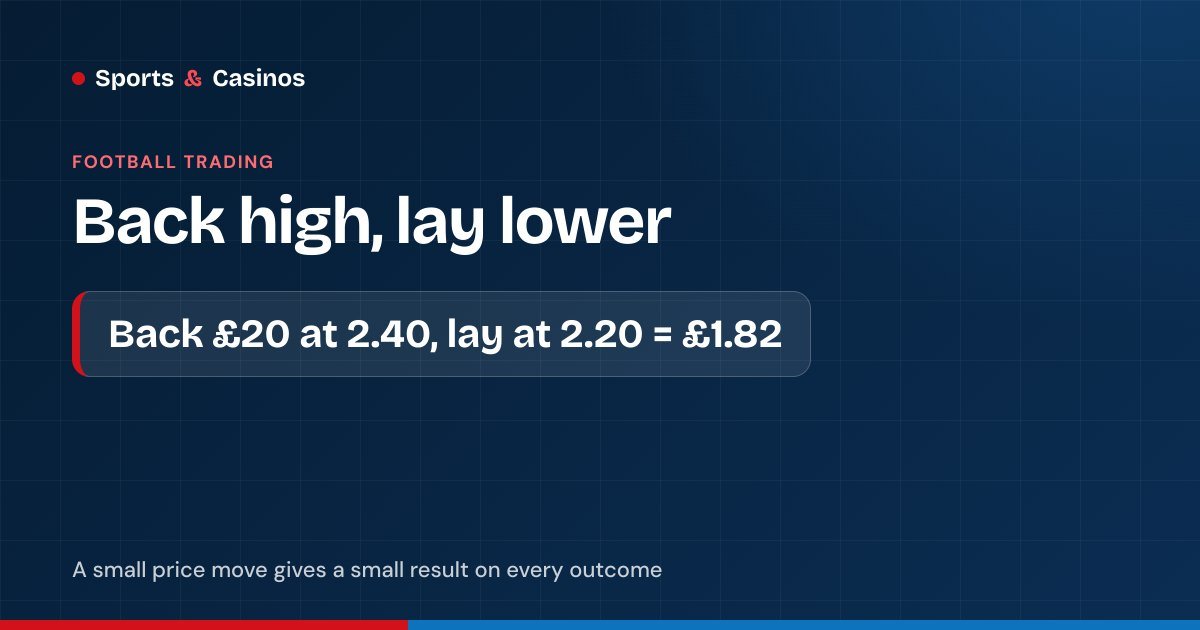
You back a team for £20 at 2.40 before kick-off. Later, the price shortens to 2.20, so you lay it.
- Lay stake: 20 × 2.40 ÷ 2.20 = £21.82.
- If the team wins: the back bet wins 20 × 1.40 = £28.00, and the lay pays out 21.82 × 1.20 = £26.18 from your liability. Net +£1.82.
- If the team does not win: the £20.00 back stake is not returned, and the lay wins £21.82. Net +£1.82.
Quick check: 20 × (2.40 ÷ 2.20 − 1) = £1.82, before commission. At 2%, used here as an example rate, commission costs about 4p, so you keep about £1.78.
That result is small next to the £20 stake. This is normal, because a move from 2.40 to 2.20 is quite small. In chance terms, 2.40 is about 41.7% and 2.20 is about 45.5%. Use the odds converter below to turn any price into a chance.
Odds converter
Liability, suspensions and timing
When you lay, your liability is the amount you would pay out if the selection wins. It equals lay stake × (lay odds − 1). In the example above, that is 21.82 × 1.20 = £26.18, which the £28.00 win covers.
Prices drift as well as shorten, so the timing of your exit matters. If you never close, you simply hold a normal £20 bet until the match ends. Also, in-play markets suspend when a goal or red card happens. So the price after the restart can be far from where you planned to exit.
What the data says about back to lay
We compared Betfair Exchange prices days before kick-off with prices at kick-off for more than 6,500 matches. The matches came from 20 European leagues between 20 October 2025 and 19 October 2026, using data from football-data.co.uk. The test was simple: back every selection early, then lay it at the kick-off price.
- Prices drifted out more often than they shortened.
- Commission made only a tiny difference to the average result, about 0.04 percentage points.
- Early books also carried more margin. For example, the match odds market had a 2.8% margin early, against 0.9% at kick-off.
In other words, the early prices tended to carry more margin and to drift before kick-off. These are averages over many matches, so they describe the market, not a method to follow.
Honest limits of the trade
The trade itself does not create value. When you back at 2.40, all you have done is take a price. The later lay just locks in what the market did next. So a back to lay trade is only as good as your reason for expecting the price to fall.
That reason has to be something the market has not priced yet, such as better judgement or information. One honest test is closing line value. If your back prices are usually worse than the kick-off price, the trade will struggle whatever exit you use.
Keep stakes small and fixed, and set your exit prices before you start. Our guide to bankroll management covers stake sizing. Also, betting variance explains why results swing from week to week. Never raise your stake to chase an earlier trade.
Related guides
18+ only. Betting should be fun, and every bet can lose. Set a budget you can afford to lose and stick to it. For free, confidential support, visit BeGambleAware.org or call the National Gambling Helpline on 0808 8020 133.