
Under 2.5 trading means backing under 2.5 goals on a betting exchange and laying it later, before full time. The under price falls as the clock runs down without goals. So if the match stays quiet, you can close the trade with the same result on every outcome.
But a goal pushes the price out sharply, so timing matters. This guide covers the steps, a worked example, and what a year of data shows.
The short version
- You back under 2.5 goals, often before kick-off, and lay it in-play.
- Time without goals shortens the price. A goal pushes it out sharply.
- Closing early gives up some upside but limits the damage from a late goal.
- In our data, 53.5% of matches went over 2.5, so the under won in 46.5%.
What is under 2.5 trading?
The under 2.5 goals market wins if the match has 0, 1 or 2 goals. Its price depends on how many goals the market expects and how much time is left. With no goals, every minute that passes makes three goals less likely, so the under price shortens.
An under 2.5 trader uses that time decay. Instead of holding the bet to full time, they lay it once the price has fallen, which locks in a result on every score. So the main difference from a plain bet is that you choose when to leave. For a refresher on lay bets, see our guide to the Betfair Exchange.
How under 2.5 trading works step by step
Read the transcript
Under two and a half goals trading uses time. Every minute without a goal makes the under more likely, so its price shortens.
Back ten pounds at two. If it's nil-nil on the hour and the under is one point three, lay fifteen pounds thirty-eight to lock in about five thirty-eight.
Last season, fifty-three point five per cent of matches went over two and a half. But twenty-nine per cent were goalless at half-time, and nearly eighty-two per cent of those stayed under two and a half.
The price shortens because the chance really rises. At nil-nil at half-time, a fair under price is about one point two two. The opportunity comes when the market is slower than the clock.
Under trading is a way to manage a position as the clock runs down. Please bet responsibly.
- Choose a match and check the under 2.5 price and how much money is waiting. Goal markets in smaller leagues can be thin.
- Back under 2.5 goals at your chosen stake.
- Set your exit rules first: a target price to lay at, and what you will do if a goal goes in.
- As time passes without goals, the price shortens. Then lay at your target, using lay stake = back stake × back odds ÷ lay odds.
- If a goal goes in early, follow the plan you set in step 3. The price often moves again after a goal, so quick decisions matter.
Under 2.5 trading worked example
Worked example
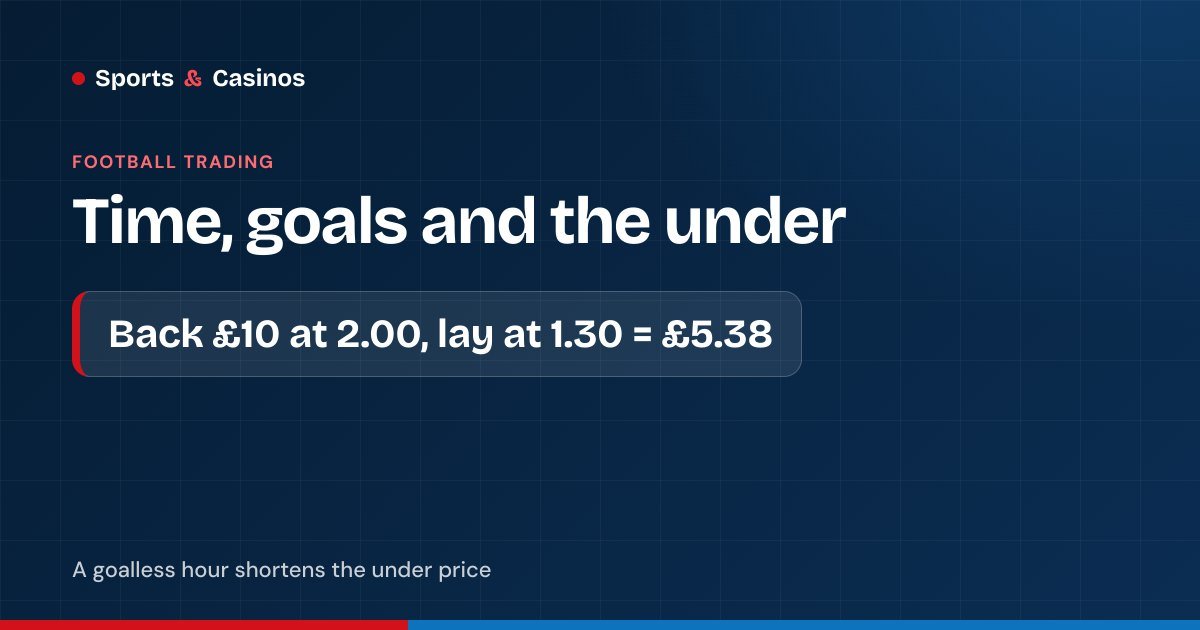
You back under 2.5 goals for £10 at 2.00 (evens) before kick-off. It is 0-0 at 60 minutes, and the under has shortened to 1.30, so you lay it.
- Lay stake: 10 × 2.00 ÷ 1.30 = £15.38.
- If there are 2 goals or fewer: the back bet wins £10.00, and the lay pays out about £4.62 from your liability. Net about +£5.38.
- If there are 3 or more goals: the £10.00 back stake is not returned, and the lay wins £15.38. Net +£5.38.
Quick check: 10 × (2.00 ÷ 1.30 − 1) = £5.38, before commission. At 2%, used here as an example rate, that costs about 11p.
Holding to full time would have paid £10 if the match stayed under. However, with 30 minutes left there was still time for goals. So closing at 60 minutes swaps a chance of an extra £4.62 for a fixed result now. Our guide to how to green up explains this sum in more detail.
Goals, suspensions and liability
A goal changes the under price at once. In-play markets suspend when a goal is scored. So you cannot lay at the old price; you get whatever price the market reopens at.
Your liability on a lay is lay stake × (lay odds − 1). In the example above, that was 15.38 × 0.30 = £4.62. If you prefer to leave in steps, our guide to drip feeding in-play bets explains spreading a lay over several prices.
What the data says about under 2.5 trading
We used football-data.co.uk results for 7,149 league matches in 20 European leagues, from 20 October 2025 to 19 October 2026.
- 53.5% of matches went over 2.5 goals, so the under won in 46.5%. The average was 2.77 goals a match, so it was a high-scoring year.
- 71.0% of matches had a first-half goal, so a goalless first half was the exception.
- When it was 0-0 at half-time (2,075 matches), only 18.1% went over 2.5.
- With exactly one first-half goal (2,545 matches), 47.9% went over 2.5.
The 0-0 at half-time figure looks tempting, but the market knows it too. At half-time in a goalless game, the under price is already short. For example, the fair price for an 81.9% chance is 1 ÷ 0.819, about 1.22. So the key is getting a better price than the true chance. These figures describe the market on average, not a method to follow.
Honest limits
The market prices time decay in minute by minute. You only come out ahead over time if your opening price was better than the true chance. That needs better judgement or information than the market.
Goal markets also swing sharply, and one late goal can change a price in seconds. So keep stakes fixed, record every trade, and read about betting variance to see why results swing. Our free Value Predictor shows goal statistics for each team, but its output is statistics, not tips. For the opposite approach, see our guide to backing goals in-play.
Related guides
- Football trading explained
- Backing goals in-play
- Over 2.5 goals: judging the price
- How to green up
- Lay 0-0
18+ only. Betting should be fun, and every bet can lose. Set a budget you can afford to lose and stick to it. For free, confidential support, visit BeGambleAware.org or call the National Gambling Helpline on 0808 8020 133.