
Price boosts are bookmaker offers that raise the odds on a chosen bet, such as a team to win at 3.00 instead of 2.50. A bigger number looks like a better deal. But a boost is only value if the new price is longer than the fair odds, and many are not.
This guide shows you how to test a boost in a minute, with a worked example and the common traps to watch for.
The short version
- A boost is value only if the boosted odds are longer than the fair odds.
- Get fair odds from an exchange midpoint or by removing the margin from a bookmaker’s market.
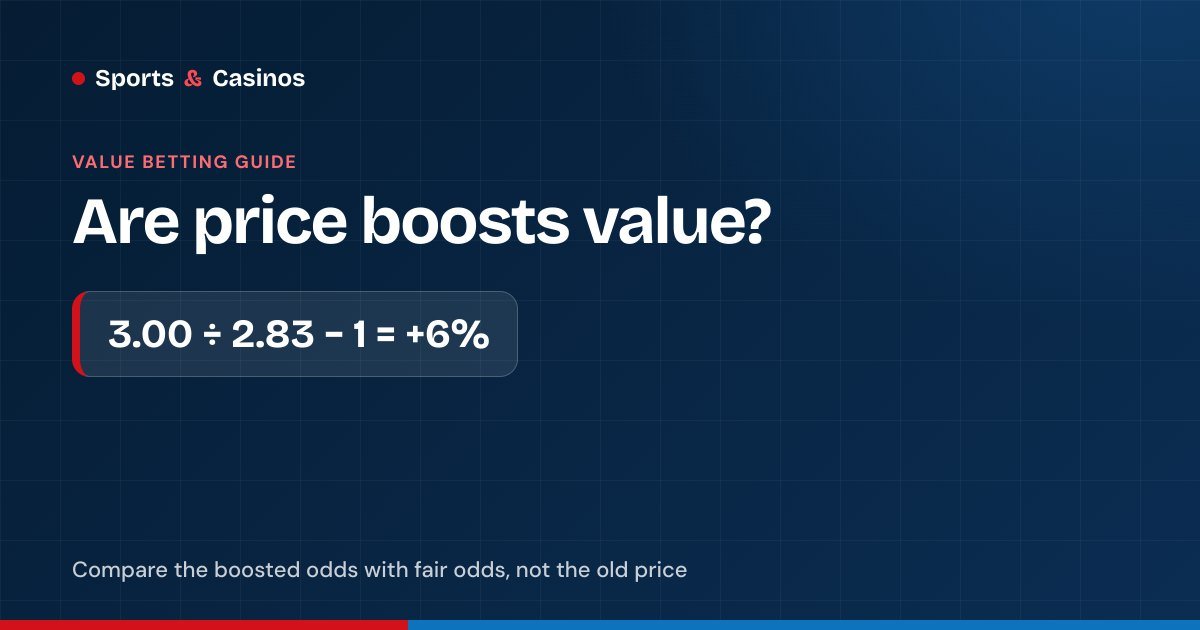
- Edge = boosted odds ÷ fair odds − 1. For example, 3.00 ÷ 2.83 − 1 = +6.0%.
- Watch for boosts from a short price, low maximum stakes and boosts on multiples.
How price boosts work
First, a bookmaker picks a bet and offers higher odds than usual, often with a cap on the stake. Some boost the whole price. Others, for example acca boosts, add a percentage to your winnings only. Either way, the “was” price is the bookmaker’s own number, which already includes its margin.
So the jump from the old price tells you little. What matters is how the new price compares with a fair one. Our guide to fair odds explains the idea in full.
How to test price boosts for value
There are two quick ways to get a fair price. Both take a minute once you know where to look.
Use the exchange
The Betfair Exchange shows a back price and a lay price for most big markets. In liquid markets, the midpoint of the two is a decent fair price. Bear in mind the exchange charges commission on net winnings, so check the current rate. Even so, the midpoint is a guide, not a perfect truth.
Remove the bookmaker’s margin
Instead, you can take a full market from a sharp bookmaker and strip out the margin. First, add up the implied chances of each outcome. Then scale each one down so the total is 100%. This is the simple proportional method, and it works well for most main markets. For background, see the mathematics of bookmaking on Wikipedia.
Worked example
A team is boosted from 2.50 to 3.00 (2/1), with a maximum stake of £10. On the exchange, the back price is 2.80 and the lay price is 2.86.
- Fair odds: the midpoint is (2.80 + 2.86) ÷ 2 = 2.83
- Fair chance: 1 ÷ 2.83 = 35.3%
- Expected value per £1: 0.353 × 3.00 − 1 = +£0.06, an edge of about 6%
- At the £10 maximum: 10 × 0.06 = about +£0.60
In short, this boost is value on paper. But the bet still loses about 65% of the time.
Use the calculator below to test any of the price boosts you see. Enter your stake, the boosted odds and the fair chance, and it shows the expected value and edge.
Expected value calculator
If you are new to this, our guide to expected value betting explains the maths step by step.
Common traps with price boosts
In practice, many boosts look generous but still fall short of fair odds. Here are the three you will see most often.
Boosted from a short price
A boost from 1.50 to 1.60 sounds good. However, if the exchange midpoint is 1.62, the boosted price is still shorter than fair. The expected value is 1.60 ÷ 1.62 − 1 = −1.2%. As a result, the “boost” is still a bet with a small built-in loss. In fact, this happens most when the original price was already well below the market.
Low maximum stake
Even a big boost with a £1 or £5 maximum is worth very little in pounds. For example, a 10% edge on a £5 stake is worth £0.50 on average. That is the long-run average, not what you get each time, so it is a small number with a big swing.
Boosts on multiples
Acca boosts are the most common trap, because each leg carries its own margin, and the margins multiply. With 4 legs at a 5% margin each, the total margin is 1.05 × 1.05 × 1.05 × 1.05 = 1.2155, or about 21.6%.
Worked example
A 4-fold acca is priced at 10.00. With a 5% margin on each leg, the fair odds are 10.00 × 1.2155 = 12.16. The bookmaker offers a 10% boost on winnings. Your winnings go from £9 to £9.90 per £1, so the odds become 10.90.
The edge is 10.90 ÷ 12.16 − 1 = −10.4%. That means the boosted acca is still well below fair odds. Therefore, most acca boosts just shave a little off a large margin.
Using price boosts with care
After all, a boost that beats fair odds is a better price, not a likely winner. Even a run of good boosts will bring long losing streaks, and the edge only shows over many bets. Also, boosts exist to bring you into a bookmaker’s markets, so do not bet more, or on things you would not normally bet on, just because a price looks bigger.
Value betting is a way to judge prices. It does not promise a profit, and most people who bet lose over time. To find the best regular prices, read our guide to odds shopping.
Related guides
18+ only. Betting should be fun, and every bet can lose. Set a budget you can afford to lose and stick to it. For free, confidential support, visit BeGambleAware.org or call the National Gambling Helpline on 0808 8020 133.